Categories
Uncategorized

The Art of Effortless Meditation

We would like to turn our attention to Dhyāna, the seventh limb of Yoga. Often translated as “meditation,” Dhyāna is more than simply closing your eyes and trying not to think. This is the practice of resting awareness in a steady, calm place.

In Yogic philosophy, the limbs before Dhyāna, movement (āsana), breath (prāṇāyāma), sense withdrawal (pratyāhāra), and concentration (dhāraṇā), all prepare us to sit with ourselves. Without these foundations, meditation often feels frustrating: the body won’t settle, the mind races, and the stillness feels out of reach. With preparation, however, meditation becomes less about fighting thoughts and more about allowing awareness to land naturally.

What Dhyāna Really Means

Dhyāna isn’t about “emptying the mind.” It’s about shifting how we relate to thoughts and sensations. Instead of chasing every distraction, we use anchors such as the breath, a mantra, a posture, or a point of focus in order to return gently to presence. Over time, this creates a state of awareness that feels clear, spacious, and deeply restful.

Why It Matters

Modern life is full of stimulation. Notifications, responsibilities, constant motion can be bombarding. Training the nervous system to pause in meditation is like training a muscle: it builds resilience, clarity, and the ability to choose how we respond rather than react. Even a few minutes each day can lower stress, improve focus, and create a steadier sense of peace.

How to Practice Dhyāna

Dhyāna, can be practiced in simple, accessible ways:

  • Prepare the body: Gentle movements or stretches help release tension so you can sit comfortably without distraction.
  • Choose an anchor: Focus on the breath, a mantra, a sound, or even the feeling of the body sitting. The anchor gives the mind a place to return when it wanders.
  • Allow thoughts to come and go: Instead of fighting distraction, notice it and gently bring awareness back to your anchor. Over time, this becomes easier and more natural.
  • Start small: Even a few minutes a day builds the skill of presence and strengthens your ability to focus and self-regulate.
  • Integrate into daily life: Use every day pauses like waiting in line, when you are sipping tea or practicing yoga as opportunities to practice awareness.

With consistent practice, Dhyāna shifts from being a technique you “do” into a natural state of clarity, calm, and effortless presence.

Categories
Uncategorized

What Is Anāhata?

The Sanskrit word Anāhata translates to “unstruck” or “unhurt.” It refers to a state of inner clarity, untouched by conflict. Physically, this energy center is located at the chest, connecting the front and back body — lungs, heart, shoulders, and upper spine. Emotionally, it is the seat of balance, forgiveness, resilience, and compassion.

When balanced, Anāhata allows us to:

  • Build healthy, reciprocal relationships
  • Show compassion without losing boundaries
  • Manage stress without shutting down
  • Shift from “me” to “we” without losing ourselves

How Yoga Supports the Heart Chakra

Yoga is not just exercise — it’s a tool for nervous system regulation and inner alignment. Each class this month is designed to strengthen and release the shoulders, chest, and upper back while using breathwork and intentional meditation to work on the deeper layers of the heart chakra.

Tools You’ll See in Class

  • Asanas (Postures): Shoulder openers, supported backbends, and chest-expanding poses help release tension where stress often lives.
  • Breathwork: Deep, rhythmic breath into the chest builds awareness and supports calm under pressure.
  • Focused Cues: Instructors will guide you to notice where you hold stress in the shoulders and how conscious release feels.
  • Meditation & Reflection: Time at the end of class to consider what you’re ready to release as the season shifts.

These are not just “concepts” — they are practices. The physical work prepares the body, the breath centers the mind, and the reflection makes the lesson stick.

How to Reflect During Practice

When you’re on the mat this month, ask yourself:

  • What am I carrying that feels heavy, and how can I set it down?
  • Where do I notice tension in my chest or shoulders?
  • What is worth carrying forward into the next season of my life?

Reflection doesn’t need to be complicated — sometimes it’s as simple as holding a posture, breathing into the discomfort, and noticing what your body wants to say.


Final Thought

This month, our yoga practice becomes a tool to move with the season rather than against it. By focusing on the heart chakra, we align our physical strength, emotional resilience, and seasonal rhythms into one steady practice.

Want to experience it more deeply? Join us in class — our instructors will guide you through the balance of strength, breath, and reflection that makes these teachings come alive.

Categories
Uncategorized

Let The Lymph Flow

How Yoga Supports the Lymphatic System and Why That Even Matters

Most people don’t think about their lymphatic system throughout the days but regardless of the neglect, it’s working for you all day, every day. Clearing out waste, moving immune cells, and trying to keep your body in balance. Unlike the circulatory system, which has a heart to keep things pumping, your lymphatic system has no central pump so it only moves when you move.

That means things like breath, posture, muscular engagement, and even stillness all have a powerful effect on how well your body can clear out what it no longer needs.

What is the Lymphatic System?

The lymphatic system is a vast network of vessels and nodes that runs throughout your body. Its primary jobs are to:

  • Drain excess fluid from tissues
  • Transport immune cells
  • Filter out waste, toxins, and pathogens
  • Support detoxification and immune regulation

Think of it as your body’s internal sanitation and defense system.

But here’s the key: it doesn’t move on its own.
Movement, compression, breath pressure, and even gravity all play a role in helping lymph flow.

How Yoga Helps

This is where traditional Yoga becomes powerful! Not just for flexibility or relaxation, but for internal regulation as certain styles and postures directly support lymphatic flow:

  • Twists and compressions help “squeeze and soak” areas of lymph congestion
  • Gentle inversions (like legs up the wall or supported bridge) use gravity to aid lymph return
  • Deep breathing activates the diaphragm, which pumps lymph upward through the thoracic duct
  • Long holds and slow transitions give the body time to circulate and clear

This is one reason why long holds and slow transitions in traditional Yoga can be deeply therapeutic. Our practice creates space for our body’s subtler systems to catch up and clear out.

We often chase intensity to feel something but it’s in the stillness and slow movement that the real reset begins.

Why Should We Care?

  • Feeling puffy, sluggish, or inflamed? Lymph stagnation may be playing a role.
  • Dealing with frequent colds or fatigue? Your immune system and lymph system work hand in hand.
  • Want more clarity and ease in your body? Start with what’s flowing beneath the surface.

What You Can Do This Month

  • Join us for lymph-focused Yoga classes all month at the studio
  • Try legs up the wall for 5 minutes a day
  • Dry brushing is also a great lymph ritual 
  • Stay hydrated, breathe deeply, and move with intention, even small movements help!

Your body doesn’t always need more effort. Sometimes, it just needs permission to flow.

See you on your mat.

Categories
Uncategorized

The Calm of Cold

❄️ Why Embracing Chill Moments Builds Strength from Within

When most people think of healing, they think of warmth — cozy blankets, heated pads, steamy showers.

But what if cold is the missing piece in your wellness routine?

From nervous system regulation to tissue resilience, intentional cold exposure is emerging as one of the most powerful (and accessible) ways to train both the body and mind to handle life more effectively. And when paired with mindful practices like Yoga, the benefits reach even deeper.

So let’s explore:

  • How Yoga introduces us to cold
  • What Yogic philosophy teaches about discomfort and self-regulation
  • And how we can create small moments of stillness, strength, and clarity — on and off the mat — through a chill approach to practice

🌬 Cold Isn’t Punishment — It’s Practice

Our bodies respond to cold instinctively: the heart rate jumps, breathing quickens, and we go into alert mode. This is our nervous system doing its job — protecting us from danger.

But here’s the secret: when we train ourselves to breathe through the cold, to stay present instead of panic, we teach our nervous system that we are safe — even in discomfort.

That’s the real benefit.


Cold Exposure Can Help You:

  • Shift into parasympathetic (rest and digest) state
  • Improve mood through increased dopamine and norepinephrine
  • Enhance focus and mental clarity
  • Build resilience by increasing stress tolerance over time
  • Reduce inflammation and support cellular recovery

And the best part? You don’t need a plunge pool to begin.


💧 Simple Ways to Invite Cold In

Here are some gentle, everyday ways to incorporate cold exposure — safely and mindfully:

  • End your shower with 30 seconds of cold water
  • Splash cold water on your hands, feet, or face — these areas cool the whole system quickly
  • Use a cold towel on your neck or chest after movement
  • Sit quietly in a cool room post-practice, without rushing into heat
  • Practice calming breathwork during mild exposure, training your body to stay regulated

These are micro-resets — small invitations to step out of reactivity and into calm.


🧘‍♀️ Where Yoga Comes In

Cold exposure is only effective if you can meet it with presence, and that’s exactly what Yoga teaches.

Yoga is a practice of discipline, observation, and control. When we breathe into discomfort, we expand our tolerance for life itself — whether it’s a cold plunge or a challenging moment at work.

In a Yogic context:

  • Pranayama (breath control) trains your ability to stay calm under pressure
  • Dharana (concentration) helps focus the mind during discomfort
  • Tapas (discipline) reminds us that growth often comes from friction, not comfort

We aren’t practicing to be bendy — we’re practicing to be steady.


❄️ Does Cold Help Your Fascia?

Many heated practices promote flexibility by increasing temperature and sweating. But here’s something to consider:

Heat makes fascia more pliable, but also more vulnerable.

When fascia is already stretched from heat and you then apply pressure or weight through deep stretching, you risk:

  • Over-extending tissue
  • Creating instability in joints
  • Building flexibility without control

In contrast, practicing in a cooler room allows you to:

  • Feel your true range of motion
  • Build strength and stability within that range
  • Avoid the illusion of flexibility that disappears when the heat is gone

Cold doesn’t limit your body — it invites more awareness.


✨ Final Thought: Cold Is a Mirror

When we meet cold with breath, presence, and discipline, we learn something deep:

We don’t have to run from discomfort.
We can stay.
We can choose calm.

Yoga and cold exposure both teach this — in their own ways.

So the next time you feel tension rising or your world speeding up, try this:
Take a breath.
Add a little cold.
Stay just a few seconds longer.
And trust that your nervous system — like your spirit — can adapt and grow stronger from it.

Namaste.

Categories
Uncategorized

A Focus on the Spine

When most people think of Yoga, they think of flexibility, strength, or stress relief. What often gets overlooked is one of the most important — and central — structures in the practice: the spine.

Why Focus on the Spine?

The spine is more than just a support system. It houses and protects the spinal cord, your body’s primary communication highway. When the spine is compromised — through poor posture, restricted mobility, or chronic tension — it affects not just movement, but also breath, energy, and overall well-being.

Tension or misalignment in the spine can lead to:

  • Limited mobility and flexibility
  • Chronic back, neck, and shoulder pain
  • Shallow breathing patterns
  • Decreased energy levels
  • Greater risk of injury

A well-aligned, mobile spine supports efficient movement and healthy breathing patterns, two pillars of both Yoga practice and daily life.

How Yoga Supports Spinal Health

In a traditional Yoga practice, we don’t just stretch — we move with the intention of strengthening and creating balance throughout the body. Specific postures (asanas) focus on:

  • Lengthening and decompressing the spine to relieve pressure
  • Building core strength to stabilize and support the spine
  • Enhancing breath awareness through spinal alignment
  • Developing mobility and flexibility to prevent stiffness and injury

Long holds, controlled breathwork, and mindful transitions — key aspects of our approach at Bakersfield Yoga — are powerful tools for improving spinal health over time.


The Pelvic Floor: The Spine’s Foundation

When it comes to supporting the spine, strength and awareness in the pelvic floor are essential — and often overlooked.

The pelvic floor acts like a muscular sling at the base of the spine. When engaged properly, it helps stabilize the pelvis and lumbar spine, creating a strong and supportive foundation for movement. A connected, responsive pelvic floor not only protects the spine during Yoga practice but also throughout everyday activities like lifting, sitting, and even breathing.

Without a strong pelvic floor:

  • The spine is left vulnerable to misalignment and instability
  • Breathing patterns become restricted
  • Core engagement becomes ineffective
  • Risk of lower back strain increases

With a properly activated pelvic floor:

  • The spine maintains better alignment and support
  • Breath becomes deeper and more efficient
  • Movement becomes more controlled and resilient
  • Postural habits improve naturally

Deepen Your Connection: Guided Pelvic Floor Meditation

To help you build both awareness and strength, I’ve recorded a guided pelvic floor meditation — based on the same technique I taught during our recent workshop. This meditation focuses on tuning into subtle activation, relaxation, and balance in the pelvic floor, offering a powerful tool for spinal health and full-body stability.

🎧 Get Access to the Pelvic Floor Meditation Recording Here

Use this meditation regularly to build the deep, stabilizing strength your spine needs to move and breathe better every day.

4 Yoga Postures to Support and Realign Your Spine

Building spinal health doesn’t have to be complicated. Here are four postures you can begin practicing today — either held for longer durations to build stability or moved through dynamically to restore mobility and balance:


1. Cat-Cow (Marjaryasana-Bitilasana)
Dynamic Movement
This gentle flow between flexion and extension reawakens spinal mobility. Moving with the breath helps lubricate the joints of the spine, increase circulation, and reset natural curves.

  • Tip: Move slowly, syncing the breath — inhale to arch (Cow), exhale to round (Cat). Focus on segmenting the spine one vertebra at a time.

2. Sphinx Pose (Salamba Bhujangasana)
Static Hold
A subtle backbend that strengthens the lumbar spine without overloading it. Sphinx pose gently restores the natural curve of the lower back and promotes spinal extension without compression.

  • Tip: Engage the lower belly and lightly press the pubic bone into the mat to support the low back while maintaining length through the spine.

3. Low Lunge with Side Bend (Anjaneyasana Variation)
Dynamic or Static
Opening the front of the hips releases tension on the pelvis, improving spinal alignment. Adding a side bend stretches the muscles along the spine, increasing lateral mobility.

  • Tip: Keep the hips square and rooted. As you side bend, imagine creating space between each rib, lengthening the side body without collapsing the spine.

4. Supine Twist (Supta Matsyendrasana)
Static Hold
Twists realign the spine by resetting muscular imbalances between the left and right sides. They also decompress the vertebrae and stimulate spinal fluid movement.

  • Tip: Focus on lengthening the spine before twisting. Keep both shoulders grounded and use breath to soften deeper into the pose rather than forcing rotation.

Incorporating these postures regularly — paired with pelvic floor awareness — can dramatically improve spinal stability, alignment, and overall resilience.

Categories
Uncategorized

What Is the Pelvic Floor?

The Power of the Pelvic Floor: What Everyone Should Know

When you think of strength, flexibility, and control in the body, your mind might go straight to big muscle groups such as the abs or the glutes. But there’s one lesser-known muscle group that quietly supports nearly everything we do, from movement to breath to emotional regulation: the pelvic floor.

Whether you’re male or female, understanding and caring for your pelvic floor can make a significant difference in your posture, strength, energy, and overall well-being. And both science and Yoga have a lot to say about why.


What Is the Pelvic Floor?

Scientifically, the pelvic floor is a group of muscles and connective tissue at the base of the pelvis. These muscles form a hammock-like structure that supports the bladder, intestines, and if applicable, the uterus. The pelvic floor also plays an essential role in:

  • Urinary and bowel control
  • Sexual function
  • Core stability and posture
  • Respiration (as it interacts with the diaphragm during breathing)

The Pelvic Floor in Yoga Philosophy

In yogic teachings, the pelvic floor is deeply connected to Muladhara (Root Chakra)—our energetic foundation. This is the seat of safety, stability, and groundedness. When the pelvic floor is weak or imbalanced (either too tight or too loose), we may feel anxious, unsteady, disconnected, or insecure physically and/or emotionally.

Engaging this area through Mula Bandha (the root lock) is a common yogic technique used to draw energy upward, stabilize postures, and build inner strength. It’s not about “clenching” but about subtle activation of the deep musculature.


Why Men AND Women Should Care

Often, pelvic floor health is discussed only in the context of childbirth or aging women, but this is a misconception. Men also experience pelvic floor dysfunction, and many could benefit from increased awareness. For both men and women, the pelvic floor:

  • Impacts low back pain, hip tightness, and alignment
  • Influences breath capacity by working with the diaphragm
  • Supports sexual health and intimacy
  • Helps manage stress and trauma responses stored in the body

Strength AND Release: Both Are Essential

One of the biggest misunderstandings is that the pelvic floor always needs to be stronger. In truth, tightness can be just as problematic as weakness.

A hypertonic (overactive) pelvic floor can cause:

  • Pain during intercourse
  • Constipation
  • Pelvic or hip pain
  • Inability to fully engage the breath
  • Feelings of anxiety or restlessness

Yoga encourages balance not just strength. Practices like deep stretching, breath awareness, and somatic movement can help release tension and bring better function and flow.


Bringing Awareness to the Pelvic Floor in Practice

At our studio, we often integrate pelvic floor cues into breathwork, posture, and mindfulness. Here’s how you can start tuning in:

  • During Breathwork: Feel the pelvic floor gently respond to your inhales and exhales. On inhale, allow it to soften; on exhale, feel a gentle lift.
  • In Postures: Think of grounding down through the sit bones and drawing awareness to the base of your spine. Be mindful not to “squeeze,” but to engage consciously.
  • Through Stillness: Use meditation and visualization to bring attention to this part of your body. Acknowledge it as part of your energetic and emotional foundation.

Why It Matters

Pelvic floor health is not just about avoiding discomfort or injury. It is about living from a place of awareness and integration. When we understand how this area affects our breath, our posture, our emotions, and our energy, we begin to move through the world differently. We can become more connected, more grounded, and more in control.


Categories
Uncategorized

The Bandhas

Unlocking the Power of the Bandhas in Yoga Practice

In the vast and rich tradition of Yoga, the bandhas stand as some of the most powerful and transformative tools for practitioners. Known as “energy locks” in Sanskrit, the bandhas are specific muscular contractions that help control the flow of prana (life energy) throughout the body. For the month of April we’re focusing on the transformative power of the bandhas, especially Maha Bandha, which includes Jalandhara Bandha, Uddiyana Bandha, Mula Bandha, as well as Hasta Bandha and Pada Bandha. 

In this post, we will explore what the bandhas are, how they function, their origins, the science behind them, and how you can start incorporating them into your practice for enhanced energy, stability, and awareness.

 What Are the Bandhas?

The word “bandha” translates to “lock” or “seal” in Sanskrit. Bandhas refer to specific muscular contractions that work to direct prana within the body. By consciously activating these locks, we create energy seals that promote stability, deepen breath control, and improve posture, ultimately leading to a more energized and mindful practice.

There are five main bandhas in total, Maha Bandha—which is a combination of the three main bandhas (Jalandhara Bandha, Uddiyana Bandha, and Mula Bandha)—as well as Hasta Bandha (hand lock) and Pada Bandha (foot lock).

 Maha Bandha – The Ultimate Lock

Maha Bandha combines three core energy locks that synergistically work together to create a powerful internal seal, redirecting prana within the body. 

– Jalandhara Bandha (Throat Lock) is activated by gently tucking the chin toward the chest, which lengthens the spine and enhances energy flow from the chest upward to the throat. This lock helps regulate the flow of energy, aiding in better breath control and creating space for the heart and throat chakras to open.

– Uddiyana Bandha (Abdominal Lock) involves drawing the abdominal muscles inward and upward toward the spine. This creates a powerful core engagement, strengthens the digestive system, and stabilizes the body. It also helps in balancing energy within the body during standing postures and deep stretches.

– Mula Bandha (Root Lock) is performed by gently lifting the pelvic floor muscles upwards and inward. It helps stabilize the base of the spine, providing a strong foundation for the rest of the body. This lock grounds the practitioner, promoting a deeper sense of connection to the earth and enhancing balance in all poses.

When used together, these three locks form Maha Bandha, which effectively redirects prana to areas of the body that need attention, creating an internal seal that amplifies energy flow and provides deep stability.

 Hasta Bandha – The Hand Lock

The Hasta Bandha refers to engaging the hands actively during asana practice. By spreading the fingers wide, pressing into the palms, and activating the muscles of the hands and forearms, we create an energetic connection from the hands to the earth. This grounding effect provides a foundation for weight-bearing poses such as Downward Dog and Plank, ensuring that energy moves evenly through the body, maintaining balance and stability. When we engage Hasta Bandha, we enhance our control, strength, and focus during hand-based postures.

 Pada Bandha – The Foot Lock

Just as Hasta Bandha stabilizes the upper body, Pada Bandha works with the feet to create a strong and balanced foundation. This lock involves lifting the arches of the feet, spreading the toes, and pressing the balls of the feet into the ground. This grounding creates a direct connection with the earth, allowing energy to flow upward through the legs and into the body. When the feet are engaged in this way, they provide stability and support in standing poses, helping to cultivate balance and proper alignment.

 The Origins and History of the Bandhas

The bandhas are deeply embedded in the history of Hatha Yoga, dating back to ancient yogic texts such as the Hatha Yoga Pradipika and the Gheranda Samhita. These texts describe the bandhas as tools for controlling the flow of prana and awakening higher levels of consciousness. Originally, bandhas were practiced by advanced yogis, combining breath control, meditation, and asana to purify the body and mind in preparation for spiritual awakening.

In modern Yoga, the bandhas have transcended their spiritual roots and are now used to enhance physical strength, stability, and alignment in postures. They offer practitioners a way to tap into their internal energy, fostering balance, focus, and mental clarity.

 The Science Behind the Bandhas

From a scientific standpoint, the bandhas work much like isometric contractions, helping to increase intra-abdominal pressure, stabilize the core, and enhance spinal alignment. The engagement of these muscle groups creates tension that improves posture, supports energy flow, and facilitates more efficient movement in both physical practice and daily life.

Incorporating the bandhas into your practice also enhances breath control. By activating the locks and controlling the flow of prana, practitioners can increase their ability to hold poses, stabilize their body, and maintain a focused state of mind. The bandhas, then, become tools that not only improve physical performance but also increase mental clarity, supporting a deeper connection to the breath and the present moment.

 How to Expect the Bandhas in Your Practice

In practice, you’ll begin to explore how to use Maha Bandha to support your posture and deepen your breathwork. As we move through asanas, you will also experience how Hasta Bandha and Pada Bandha help stabilize and strengthen your body, creating a balanced connection from the hands to the feet.

We encourage you to practice engaging the bandhas mindfully, noticing how they affect your stability, alignment, and energy levels. As you deepen your understanding of the bandhas, you may begin to notice that they not only improve your physical strength but also help you cultivate a deeper sense of presence in your practice.

 Ready to Dive Deeper?

By exploring and practicing the bandhas, you can tap into a powerful source of internal energy and stability. Whether you are a beginner or advanced practitioner, integrating the bandhas will enhance your connection to your body, breath, and mind.

For a deeper dive into the origins, benefits, and practical applications of the bandhas, join us in class this month. You can also read more about how to integrate the bandhas into your practice by checking out our full blog post.

If you have any additional questions or need clarification on any points, don’t hesitate to ask during your next class, or reach out via email. We’re excited to guide you through this powerful exploration of energy and stability!

Categories
Uncategorized

Asteya: (Non-Stealing) and Its Role in Our Practice

Asteya: Non-Stealing and Its Role in Yoga Practice at Bakersfield Yoga

At Bakersfield Yoga, we believe that yoga is much more than just the physical postures we practice on the mat. It’s a holistic journey that engages the mind, body, and spirit, and that journey extends far beyond the studio. One of the most powerful teachings in the yogic philosophy is found in the Yamas, the ethical guidelines for living a balanced and harmonious life. Among these, Asteya, or non-stealing, stands out as a key principle that influences not only our practice on the mat but also how we show up in the world around us.

In this post, we’ll dive into the practice of Asteya, its significance within the broader framework of the Yamas, and how you can integrate this powerful principle into your daily life, both on and off the mat.

Understanding Asteya (Non-Stealing)

Asteya is the third of the five Yamas, which are the ethical guidelines laid out by Patanjali in the Yoga Sutras. These Yamas—Ahimsa (non-violence), Satya (truthfulness), Asteya (non-stealing), Brahmacharya (moderation), and Aparigraha (non-possessiveness)—offer a roadmap for how we can live a life of mindfulness, peace, and connection.

Asteya translates to “non-stealing” and can be understood in several ways. On the surface, it may seem to only apply to material theft—taking something that doesn’t belong to you. However, Asteya goes much deeper than this, touching on the concept of respecting the present moment, the energy and time of others, and even our own mental space.

Asteya teaches us that we should not take what is not freely given, but it also encourages us to be aware of what we “take” from the world around us in subtle ways. In yoga, this can relate to how we move through our practice: rushing through postures, skipping moments of stillness, or blending movements in a way that steals the full potential of each pose.

Asteya On the Mat: Slowing Down the Practice

At Bakersfield Yoga, we often emphasize the importance of mindfulness and connection in every posture. One of the most common places where Asteya can be observed is in the “vinyasa” flow sequence, which consists of the following postures: Phalakasana (Plank), Chaturanga Dandasana (Four-Limbed Staff Pose), Urdhva Mukha Svanasana (Upward-Facing Dog), and Adho Mukha Svanasana (Downward-Facing Dog).

For many practitioners, there’s a tendency to rush through these transitions, often merging the Upward Dog into Chaturanga, skipping the moment of connection between the two poses. This rush through the practice can be seen as a form of stealing—stealing from the present moment, stealing from the benefits that each posture offers, and stealing from the depth of awareness that comes with giving each pose its full attention.

Asteya on the mat teaches us to slow down, to be fully present in each posture, and to avoid blending poses just to move more quickly through the sequence. When we truly inhabit each posture, we unlock the potential for greater strength, mobility, and mindfulness. Each pose, no matter how brief, has its own purpose and deserves a moment of full engagement. By practicing Asteya, we honor that moment, and in turn, our practice becomes deeper and more meaningful.

Asteya Off the Mat: Bringing Non-Stealing Into Daily Life

Asteya isn’t just something we practice during asana (the physical practice of yoga); it extends into every part of our lives. Off the mat, Asteya encourages us to respect the boundaries, time, and energy of others and to recognize the ways in which we might “steal” from those around us. Here are a few practical ways to apply Asteya in your daily life:

  1. Stealing Time: In today’s fast-paced world, time is one of our most valuable resources. Asteya reminds us to be mindful of how we spend our time and how we take up the time of others. Are we fully present in conversations, or are we distracted by our phones? Are we honoring the time of our loved ones and colleagues by being punctual and engaged? Practicing Asteya means being aware of how we allocate and respect time.
  2. Stealing Energy: Asteya also teaches us to be aware of how we give and receive energy. Are we taking more than we are giving, whether in relationships, work, or our community? Are we draining others with our negativity or unbalanced needs, or are we contributing positively to the energy around us? Being mindful of how we exchange energy ensures that we don’t take more than is given freely.
  3. Stealing Space: Both physically and mentally, we can sometimes “steal” space by crowding others or by not respecting their personal boundaries. Whether in a crowded public space or in a conversation, it’s important to recognize when we might be imposing on someone else’s physical or emotional space. Asteya asks us to respect these boundaries, giving others the room they need to exist fully.
  4. Stealing from Ourselves: Often, we can be our own biggest thief. We steal from ourselves when we don’t make time for self-care, when we don’t honor our own needs, or when we get caught up in self-criticism. Asteya invites us to respect ourselves as much as we respect others. This means taking the time to nurture our well-being, setting boundaries, and giving ourselves the space to grow without judgment.

Practical Ways to Implement Asteya Into Your Life

To truly grasp Asteya and integrate it into your life, consider these practices:

  • Mindful Presence: In everything you do, aim to be fully present. Whether you’re engaging in a conversation, practicing yoga, or spending time with family, give your full attention to the moment. This simple act of mindfulness ensures that you’re not stealing attention away from what’s happening right in front of you.
  • Pause Before Acting: In moments of action, take a brief pause. Before rushing through your tasks or interactions, stop and ask yourself if you’re respecting the moment and the people around you. This pause allows you to check in with your intentions and make sure you’re acting from a place of mindfulness and respect.
  • Give Freely: Practice generosity by giving your time, attention, and energy freely to others. When you give, do so without expectation, knowing that you’re contributing to the collective energy of the world.
  • Self-Reflection: Regularly take time to reflect on how you may be “stealing” from yourself or others. Consider areas of your life where you can improve your awareness and practice Asteya more fully.

Final Thoughts

At Bakersfield Yoga, we believe that the practice of Asteya is a gateway to a deeper, more meaningful life—both on and off the mat. By slowing down in our practice, respecting the present moment, and recognizing how we interact with the world around us, we cultivate a sense of peace, harmony, and connection. As we continue to explore Asteya in our classes this month, we invite you to join us in honoring each moment and each posture, bringing the practice of non-stealing into every aspect of your life.

Namaste,
Bakersfield Yoga

Categories
Uncategorized

The Power of Yoga Asana for Hamstring Health

Why Care About Your Hamstrings?

Hamstrings are often the unsung heroes of our daily movements. Located at the back of the thigh, these three muscles play a vital role in bending the knee and extending the hip, essential actions for walking, running, and jumping. Despite their importance, hamstrings are frequently tight and neglected, leading to a host of issues such as lower back pain, knee problems, and restricted mobility.

Taking care of your hamstrings is not just about avoiding discomfort. Flexible and strong hamstrings enhance overall athletic performance, improve posture, and contribute to better movement patterns. In short, happy hamstrings lead to a better quality of life for us all!

Yoga: The Ultimate Hamstring Healer

Yoga is a holistic practice that can significantly improve hamstring flexibility and strength. Here are some fascinating facts about how yoga benefits the hamstrings:

  1. Enhancing Flexibility: Yoga poses like Standing Forward Bend (Uttanasana) and Seated Forward Bend (Paschimottanasana) deeply stretch the hamstrings, increasing their length and flexibility over time.
  2. Preventing Injuries: Regular yoga practice helps in preventing common injuries related to tight hamstrings. By alleviating tightness, yoga reduces the risk of lower back pain, knee pain, and hip problems.
  3. Boosting Athletic Performance: Flexible and strong hamstrings are crucial for athletes. Yoga enhances flexibility, balance, and overall strength, benefiting runners, cyclists, and sports enthusiasts.
  4. Mind-Body Connection: Yoga emphasizes mindfulness and body awareness, helping you understand your hamstrings’ limitations and progress. This awareness promotes safer and more effective stretching practices.
  5. Holistic Benefits: Beyond physical improvements, yoga provides mental and emotional benefits. Stretching the hamstrings can reduce stress, improve mood, and enhance overall well-being.
  6. Variation in Flexibility: Flexibility varies greatly among individuals due to factors like genetics, age, and lifestyle. Yoga offers modifications and variations for different flexibility levels, making it accessible to everyone.
  7. Improving Posture: Tight hamstrings can affect posture and spinal alignment. Yoga helps lengthen the hamstrings, promoting better posture and reducing the likelihood of a rounded lower back.
  8. Progressive Stretching: Yoga teaches progressive stretching, gradually increasing the intensity of stretches. This approach prevents overstretching and injuries while effectively improving flexibility.
  9. Balance Between Strength and Flexibility: Yoga focuses on achieving a balance between strength and flexibility in the hamstrings, supporting better movement patterns and overall physical health.
  10. Incorporating Breath: Breath is a powerful tool in yoga. Breathing techniques help deepen stretches and enhance relaxation, allowing for a more effective and enjoyable practice.

Key Yoga Poses for Hamstring Health

Here are some yoga postures that specifically target the hamstrings:

  • Standing Forward Bend (Uttanasana): Deeply stretches the hamstrings as you fold forward over your legs.
  • Pyramid Pose (Parsvottanasana): Stretches one hamstring at a time by folding over one straight leg.
  • Downward-Facing Dog (Adho Mukha Svanasana): A foundational pose that stretches the hamstrings as you press your heels toward the ground.
  • Seated Forward Bend (Paschimottanasana): Involves folding forward over your extended legs, stretching the hamstrings.
  • Head-to-Knee Forward Bend (Janu Sirsasana): Stretches the hamstrings by folding forward over one extended leg.
  • Wide-Legged Forward Bend (Prasarita Padottanasana): Stretches the hamstrings as you fold forward between your legs in a wide stance.
  • Reclining Hand-to-Big-Toe Pose (Supta Padangusthasana): Lying on your back, extend one leg upward, holding your big toe or using a strap to stretch the hamstring.

Join Us on the Mat

At Bakersfield Yoga, we believe in the transformative power of yoga for both body and mind. Our classes are designed to help you unlock the full potential of your hamstrings, improving flexibility, strength, and overall well-being. Whether you’re a seasoned yogi or a beginner, our experienced instructors will guide you through safe and effective practices tailored to your needs. Join us on the mat and experience the benefits for yourself!

Categories
Uncategorized

Chandra Namaskar

Honoring the moon in a yoga practice can be a deeply spiritual and rejuvenating experience. The moon represents the feminine energy, intuition, and the cycles of nature. Here are some traditional ways to honor the moon in your yoga practice:

Chandra Namaskar

Chandra Namaskar, or Moon Salutation, is a relatively recent addition to traditional yoga practices. Unlike Surya Namaskar (Sun Salutation), which has ancient roots and is extensively documented in traditional yoga texts, Chandra Namaskar does not have a well-documented historical background. It is believed to have been developed in the late 20th century as a complementary practice to the Sun Salutation, reflecting the balance between solar and lunar energies in the body. Where Surya Namaskars are energizing and heating, Chandra Namaskars are intended to be more soothing and introspective. The Chandra Namaskar sequence honors moon energy, calming, and reflective aspects of lunar energy.

Our sequence of Chandra Namaskar

The sequence of Chandra Namaskar can vary, so we chose this version of the sequence to practice: 

  1. Pranamasana (Prayer Pose): Begin by standing in Tadasana (Mountain Pose) with feet together, hands in a prayer position at the heart center.
  2. Urdhva Hastasana (Upward Salute): Inhale and lift the arms overhead, Exhale arching to the right, inhale back to center exhale to the left, inhale to center.
  3. Utkata Konasana (Goddess) 
  4. Anjaneyasana (crescent or low lunge) “toward the back”
  5. Ardha Chandrasana (Half Moon)
  6. Uttanasana (forward fold)
  7. Urdhva Hastasana (Upward Salute): Inhale and lift the arms overhead, Exhale arching to the right, inhale back to center exhale to the left, inhale to center.
  8. Utkata Konasana (Goddess) “back to same side”
  9. Anjaneyasana (crescent or low lunge) “toward the front”
  10. Ardha Chandrasana (Half Moon)
  11. Uttanasana (forward fold)
  12. Urdhva Hastasana (Upward Salute)
  13. Pranamasana (Prayer Pose)

Yin Yoga

– Yin yoga involves holding poses for longer periods, which complements the calming energy of the moon. A focus on hip openers and forward bends promote grounding and introspection.

Lunar Phases and Intentions

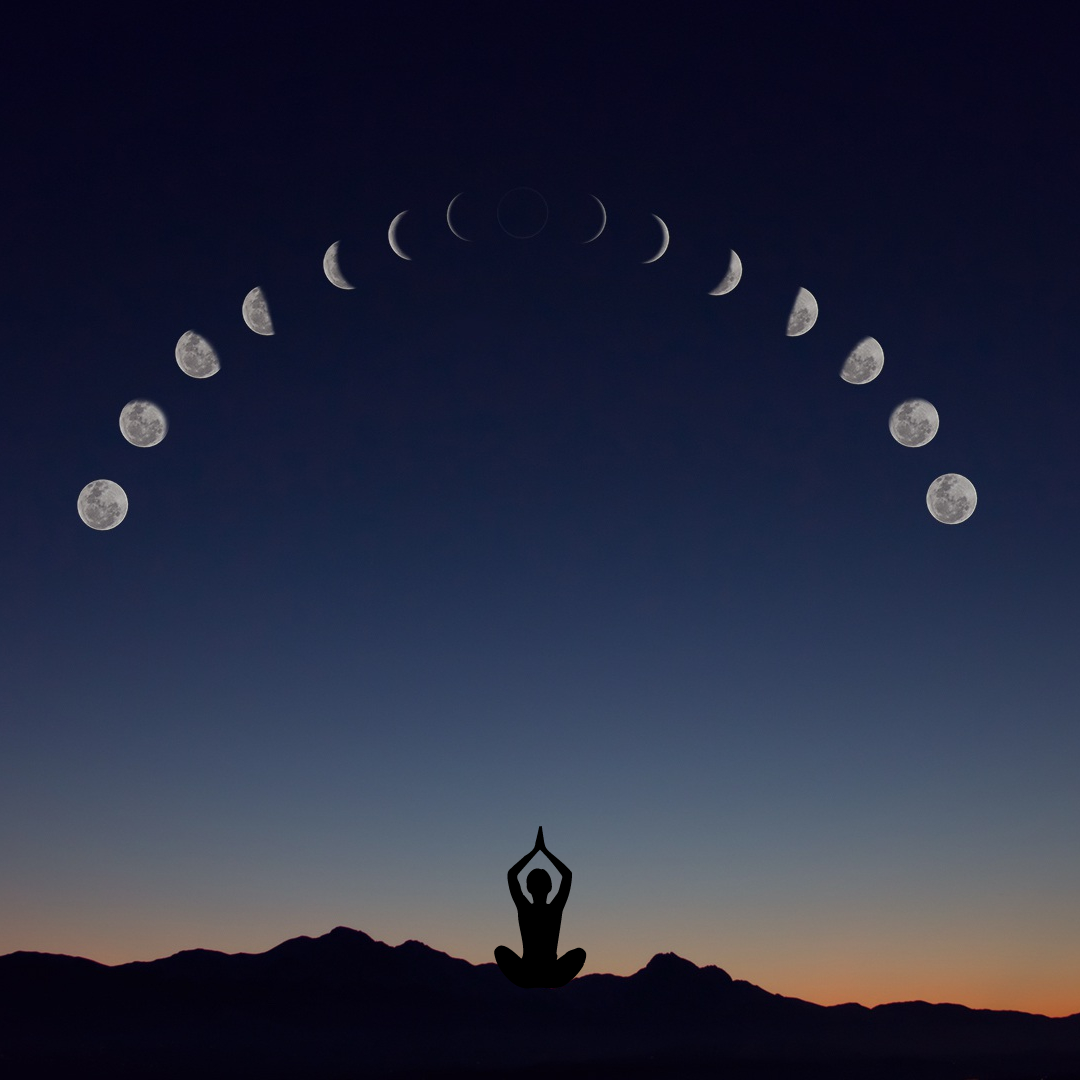
Align your practice with the phases of the moon:

  • New Moon: Set intentions, meditate, and focus on new beginnings.
  • Waxing Moon: Build energy and focus on growth and manifestation.
  • Full Moon: Celebrate achievements, practice gratitude, and engage in heart-opening poses.
  • Waning Moon: Let go of what no longer serves you, practice restorative yoga, and cleanse your space.

5. Moon Gazing (Chandra Darshan)

Spend time outdoors during the evening, observing the moon. Incorporate gentle stretches or a meditation session while gazing at the moon, absorbing its tranquil energy.

6. Use of Mantras

Chanting moon-related mantras can enhance the spiritual aspect of your practice. The mantra “Om Chandraya Namaha” is a traditional Vedic mantra to honor the moon.

7. Creating a Moon Altar

Set up a small altar with symbols that represent the moon, such as moonstones, silver objects, white candles, and images of the moon. Practice yoga near your altar to deepen your connection to lunar energy.

8. Moon Bathing

On a full moon night, practice your yoga sequence outdoors under the moonlight. The exposure to moonlight can be soothing and balancing for your body and mind.

9. Journaling and Reflection

After your practice, spend some time journaling your thoughts, emotions, and any insights that arose during your session. Reflect on how the moon’s energy influences your inner world.

Incorporating these practices into your yoga routine can help you honor the moon’s gentle yet powerful energy, fostering a deeper connection with the natural rhythms of the universe.